

Genetic Variation In A Population Of Animals Or Plants Depends Mainly On Which Of The Following?
Genetic variation is the difference in DNA amidst individuals[one] or the differences between populations.[2] The multiple sources of genetic variation include mutation and genetic recombination.[three] Mutations are the ultimate sources of genetic variation, merely other mechanisms, such as sexual reproduction and genetic drift, contribute to it, besides.[two]

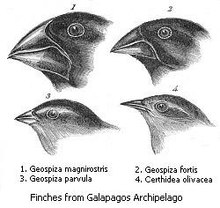
Darwin's finches or Galapagos finches.[4]

Parents accept similar gene coding in this specific situation where they reproduce and variation in the offspring is seen. Offspring containing the variation as well reproduce and passes down traits to their offspring.
Among individuals within a population [edit]
Genetic variation tin can be identified at many levels. Identifying genetic variation is possible from observations of phenotypic variation in either quantitative traits (traits that vary continuously and are coded for by many genes (e.grand., leg length in dogs)) or discrete traits (traits that fall into discrete categories and are coded for past one or a few genes (e.k., white, pink, or scarlet petal color in certain flowers)).[ citation needed ]
Genetic variation can also be identified by examining variation at the level of enzymes using the process of protein electrophoresis.[five] Polymorphic genes take more than than one allele at each locus. One-half of the genes that code for enzymes in insects and plants may be polymorphic, whereas polymorphisms are less common among vertebrates.[ citation needed ]
Ultimately, genetic variation is caused by variation in the order of bases in the nucleotides in genes. New applied science at present allows scientists to direct sequence Deoxyribonucleic acid, which has identified even more genetic variation than was previously detected by protein electrophoresis. Examination of Dna has shown genetic variation in both coding regions and in the noncoding intron region of genes.[ citation needed ]
Genetic variation will event in phenotypic variation if variation in the guild of nucleotides in the DNA sequence results in a divergence in the society of amino acids in proteins coded by that DNA sequence, and if the resultant differences in amino-acrid sequence influence the shape, and thus the function of the enzyme.[6]
Betwixt populations [edit]
Geographic variation ways genetic differences in populations from different locations. This is acquired by natural pick or genetic migrate.
Measurement [edit]
Genetic variation within a population is commonly measured as the percentage of polymorphic factor loci or the percentage of gene loci in heterozygous individuals.
Sources [edit]
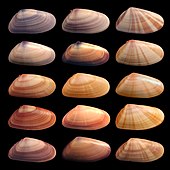
A range of variability in the mussel Donax variabilis
Random mutations are the ultimate source of genetic variation. Mutations are probable to be rare, and most mutations are neutral or deleterious, merely in some instances, the new alleles can exist favored past natural selection. Polyploidy is an example of chromosomal mutation. Polyploidy is a condition wherein organisms have three or more than sets of genetic variation (3n or more).
Crossing over (genetic recombination) and random segregation during meiosis tin can result in the production of new alleles or new combinations of alleles. Furthermore, random fertilization as well contributes to variation. Variation and recombination tin can exist facilitated by transposable genetic elements, endogenous retroviruses, LINEs, SINEs, etc.[ citation needed ] For a given genome of a multicellular organism, genetic variation may be acquired in somatic cells or inherited through the germline.
Forms [edit]
Genetic variation tin exist divided into different forms according to the size and blazon of genomic variation underpinning genetic modify. Modest sequence variation (<1 kilobase, kb) includes base-pair substitution and indels.[7] Big-scale structural variation (>one kb) can be either copy number variation (loss or gain), or chromosomal rearrangement (translocation, inversion, or Segmental acquired uniparental disomy).[vii] Genetic variation and recombination by transposable elements and endogenous retroviruses sometimes is supplemented by a variety of persistent viruses and their defectives which generate genetic novelty in host genomes. Numerical variation in whole chromosomes or genomes can exist either polyploidy or aneuploidy.
Maintenance in populations [edit]
A variety of factors maintain genetic variation in populations. Potentially harmful recessive alleles can exist hidden from selection in the heterozygous individuals in populations of diploid organisms (recessive alleles are just expressed in the less common homozygous individuals). Natural selection tin also maintain genetic variation in balanced polymorphisms. Balanced polymorphisms may occur when heterozygotes are favored or when pick is frequency dependent.
RNA viruses [edit]
A loftier mutation rate caused by the lack of a proofreading mechanism appears to be a major source of the genetic variation that contributes to RNA virus development.[8] Genetic recombination as well has been shown to play a key role in generating the genetic variation that underlies RNA virus evolution.[8] Numerous RNA viruses are capable of genetic recombination when at least two viral genomes are present in the same host cell.[ix] RNA recombination appears to be a major driving strength in determining genome compages and the course of viral evolution among Picornaviridae ((+)ssRNA) (e.g. poliovirus).[10] In the Retroviridae ((+)ssRNA)(e.one thousand. HIV), harm in the RNA genome appears to be avoided during opposite transcription by strand switching, a form of genetic recombination.[xi] [12] [13] Recombination also occurs in the Coronaviridae ((+)ssRNA) (e.thousand. SARS).[xiv] Recombination in RNA viruses appears to be an adaptation for coping with genome damage.[nine] Recombination tin can occur infrequently between animal viruses of the same species but of divergent lineages. The resulting recombinant viruses may sometimes crusade an outbreak of infection in humans.[xiv]
History of genetic variation [edit]
Evolutionary biologists are often concerned with genetic variation, a term which in mod times has come up to refer to differences in Dna sequences amongst individuals. However, quantifying and understanding genetic variation has been a fundamental aim of those interested in agreement the varied life on earth since long before the sequencing of the first full genome, and even earlier the discovery of DNA as the molecule responsible for heredity.
While today'southward definition of genetic variation relies on contemporary molecular genetics, the idea of heritable variation was of central importance to those interested in the substance and development of life even earlier the writings of Charles Darwin. The concept of heritable variation—the presence of innate differences between life forms that are passed from parents to offspring, especially inside categories such as species—does not rely on mod ideas of genetics, which were unavailable to 18th- and 19th-century minds.
Pre-Darwinian concepts of heritable variation [edit]
In the mid-1700s, Pierre Louis Maupertuis, a French scholar now known primarily for his piece of work in mathematics and physics, posited that while species have a true, original course, accidents during the evolution of nascent offspring could introduce variations that could accumulate over time.[15] In his 1750 Essaie de Cosmologie, he proposed that the species we come across today are simply a modest fraction of the many variations produced by "a bullheaded destiny," and that many of these variations did not "conform" to their needs, thus did non survive.[16] In fact, some historians even suggest that his ideas anticipated the laws of inheritance further developed by Gregor Mendel.[17]
Simultaneously, French philosopher Denis Diderot proposed a different framework for the generation of heritable variation. Diderot borrowed Maupertuis' idea that variation could exist introduced during reproduction and the subsequent growth of offspring,[18] and thought that product of a "normal" organism was no more likely than production of a "monstrous" one.[xix] However, Diderot likewise believed that matter itself had lifelike properties and could self-assemble into structures with the potential for life.[18] Diderot's ideas on biological transformation, introduced in his 1749 work Letter on the Bullheaded, were thus focused on variability of spontaneously generated forms, not variability inside existing species.[twenty]
Both Maupertuis and Diderot built on the ideas of Roman poet and philosopher Lucretius, who wrote in De rerum natura that all the universe was created past random adventure, and only the beings that were non self-contradictory survived.[21] Maupertuis' work is distinguished from the work of both Lucretius and Diderot in his use of the concept of conformity in explaining differential survival of beings, a new idea amongst those who believed that life inverse over time.[21]
Like Diderot, two other influential minds of the 18th century—Erasmus Darwin and Jean-Baptiste Lamarck—believed that merely very simple organisms could be generated by spontaneous generation, so another mechanism was necessary to generate the groovy variability of complex life observed on earth.[fifteen] Erasmus Darwin proposed that changes acquired during an animal's life could be passed to its offspring, and that these changes seemed to exist produced past the animal's endeavors to meet its bones needs.[22] Similarly, Lamarck's theory of the variability among living things was rooted in patterns of use and disuse, which he believed led to heritable physiological changes.[15] Both Erasmus Darwin and Lamarck believed that variation, whether it arose during evolution or during the creature'due south life, was heritable, a key stride in theories of modify over time extending from individuals to populations.
In the subsequent century, William Herschel'due south telescopic observations of diverse nebulae beyond the night heaven suggested to him that unlike nebulae could each be in different stages in the procedure of condensation. This idea, which came to be known as the nebular hypothesis, suggested that natural processes could both create order out of affair and introduce variation, and that these processes could be observed over time.[fifteen] While it may seem to the modern reader that astronomical theories are irrelevant to theories of organic variation, these ideas became significantly conflated with ideas of biological transformation—what we now know as evolution—in the mid-19th century, laying important groundwork for the piece of work of subsequent thinkers such equally Charles Darwin.[23]
Darwin's concept of heritable variation [edit]
Charles Darwin'southward ideas of heritable variation were shaped by both his own scientific work and the ideas of his contemporaries and predecessors.[24] Darwin ascribed heritable variation to many factors, but particularly emphasized environmental forces interim on the trunk. His theory of inheritance was rooted in the (at present disproven) idea of gemmules - pocket-size, hypothetical particles, which capture the essence of an organism and travel from all over the body to the reproductive organs, from which they are passed to offspring.[25] Darwin believed that the causal relationship between the surroundings and the body was so complex that the variation this relationship produced was inherently unpredictable.[26] Nevertheless, similar Lamarck, he acknowledged that variability could also be introduced by patterns of use and disuse of organs.[27] Darwin was fascinated by variation in both natural and domesticated populations, and his realization that individuals in a population exhibited seemingly purposeless variation was largely driven past his experiences working with animal breeders.[28] Darwin believed that species changed gradually, through the accumulation of small, continuous variations, a concept that would remain hotly contested into the 20th century.[29]
Post-Darwinian concepts of heritable variation [edit]
In the 20th century, a field that came to be known equally population genetics developed. This field seeks to understand and quantify genetic variation.[29] The section below consists of a timeline of selected developments in population genetics, with a focus on methods for quantifying genetic variation.
- 1866 - Heterozygosity: Gregor Mendel's hybridization experiments introduced the concept that in the 1950s came to be recognized as heterozygosity.[27] In a diploid species, ane that contains two copies of Deoxyribonucleic acid within each cell (one from each parent), an individual is said to be a heterozygote at a detail location in the genome if its two copies of Dna differ at that site. Heterozygosity, the average frequency of heterozygotes in a population, became a fundamental mensurate of the genetic variation in a population by the mid-20th century.[thirty] If the heterozygosity of a population is zero, every private is homozygous; that is, every individual has ii copies of the same allele at the locus of interest and no genetic variation exists.
- 1918 - Variance: In a seminal paper entitled "The correlation between relatives on the supposition of Mendelian inheritance", R.A. Fisher introduced the statistical concept of variance; the average of squared deviations of a collection of observations from their hateful ( ), where is the variance and is the mean of the population from which the observations are drawn).[31] R.A. Fisher's piece of work in population genetics was not just of import to population genetics; these ideas would also grade the foundations of modern statistics.
- 1921 - Condiment and dominant genetic variance: R.A. Fisher subsequently subdivided his general definition of variance into two components relevant to population genetics: additive and dominant genetic variance.[32] An additive genetic model assumes that genes do not collaborate and that a trait value can be estimated simply by summing the effect of each gene on the trait. Under Fisher's model, the total genetic variance is the sum of the additive genetic variance (the variance in a trait due to these additive furnishings) and the dominant genetic variance (which accounts for interactions between genes).[31]
- 1948 - Entropy: Unlike variance, which was developed with the purpose of quantifying genetic variance, Claude Shannon's measure out of diversity, now known as Shannon entropy, was adult as part of his work in communication theory as a fashion to quantify the amount of information contained in a message. However, the method quickly institute utilize in population genetics, and was the central method used to quantify genetic diversity in a seminal paper by Richard Lewontin, "The Circulation of Homo Genetic Diversity."[33]
- 1951' - F-statistics: F-statistics, also known equally fixation indices, were developed past population geneticist Sewall Wright to quantify differences in genetic variation inside and betwixt populations. The most mutual of these statistics, FST, considers in its simplest definition two different versions of a gene, or alleles, and two populations that contain one or both of these two alleles. FST quantifies the genetic variability among these two populations past computing the boilerplate frequency of heterozygotes beyond the two populations relative to the frequency of heterozygotes if the two populations were pooled.[34] F-statistics introduced the idea of quantifying hierarchical concepts of variance and would get the foundation of many important population genetic methods, including a set of methods that tests for evidence of natural choice in the genome.[35]


Run across also [edit]
- Genetic multifariousness
- Genetic variability
- Human being genetic variation
References [edit]
- ^ "What is genetic variation?". EMBL-EBI Railroad train online. 2017-06-05. Retrieved 2019-04-03 .
- ^ a b "Genetic Variation". Genome.gov . Retrieved 2020-09-28 .
- ^ Levinson, Gene (2020). Rethinking development: the revolution that's hiding in plain sight. World Scientific. ISBN9781786347268.
- ^ Darwin, 1845. Journal of researches into the natural history and geology of the countries visited during the voyage of H.Thou.Due south. Beagle round the world, nether the Command of Capt. Fitz Roy, R.Northward. 2d edition.
- ^ "What is gel electrophoresis?".
- ^ Pavlopoulos, GA; Oulas, A; Iacucci, East; Sifrim, A; Moreau, Y; Schneider, R; Aerts, J; Iliopoulos, I (25 July 2013). "Unraveling genomic variation from adjacent generation sequencing data". BioData Mining. 6 (1): xiii. doi:10.1186/1756-0381-6-13. PMC3726446. PMID 23885890.
- ^ a b Lars Feuk, Andrew R. Carson & Stephen Due west. Scherer (February 2006). "Structural variation in the man genome". Nature Reviews Genetics. 7 (two): 85–97. doi:x.1038/nrg1767. PMID 16418744. S2CID 17255998.
- ^ a b Carrasco-Hernandez R et al. Are RNA Viruses Candidate Agents for the Next Global Pandemic? A Review. ILAR J. 2017 Dec fifteen;58(3):343-358. doi: ten.1093/ilar/ilx026. PMID 28985316; PMCID: PMC7108571.
- ^ a b Barr JN, Fearns R (June 2010). "How RNA viruses maintain their genome integrity". The Journal of General Virology. 91 (Pt 6): 1373–87. doi:ten.1099/vir.0.020818-0. PMID 20335491.
- ^ Muslin C, Mac Kain A, Bessaud M, Blondel B, Delpeyroux F (September 2019). "Recombination in Enteroviruses, a Multi-Step Modular Evolutionary Process". Viruses. 11 (9): 859. doi:ten.3390/v11090859. PMC6784155. PMID 31540135.
- ^ Hu WS, Temin HM (November 1990). "Retroviral recombination and reverse transcription". Science. 250 (4985): 1227–33. Bibcode:1990Sci...250.1227H. doi:ten.1126/science.1700865. PMID 1700865.
- ^ Rawson JM, Nikolaitchik OA, Keele BF, Pathak VK, Hu WS (November 2018). "Recombination is required for efficient HIV-1 replication and the maintenance of viral genome integrity". Nucleic Acids Research. 46 (xx): 10535–45. doi:10.1093/nar/gky910. PMC6237782. PMID 30307534.
- ^ Bernstein H, Bernstein C, Michod RE (January 2018). "Sexual activity in microbial pathogens". Infection, Genetics and Evolution. 57: viii–25. doi:10.1016/j.meegid.2017.x.024. PMID 29111273.
- ^ a b Su South, Wong K, Shi W, Liu J, Lai Air-conditioning, Zhou J, et al. (June 2016). "Epidemiology, Genetic Recombination, and Pathogenesis of Coronaviruses". Trends in Microbiology. 24 (six): 490–502. doi:10.1016/j.tim.2016.03.003. PMC7125511. PMID 27012512.
- ^ a b c d Bowler, Peter J. (1989). Evolution: the history of an thought (Rev. ed.). Berkeley: University of California Press. ISBN0-520-06385-vi. OCLC 17841313.
- ^ Glass, Bentley (1947). "Maupertuis and the Beginnings of Genetics". The Quarterly Review of Biology. 22 (3): 196–210. doi:x.1086/395787. ISSN 0033-5770. PMID 20264553. S2CID 28185536.
- ^ Sandler, Iris (1983). "Pierre Louis Moreau de Maupertuis: A forerunner of Mendel?". Periodical of the History of Biology. xvi (1): 102. doi:10.1007/bf00186677. ISSN 0022-5010. PMID 11611246. S2CID 26835071.
- ^ a b Gregory, Mary (2006-x-23). Diderot and the Metamorphosis of Species. Routledge. doi:ten.4324/9780203943823. ISBN978-one-135-91583-4.
- ^ Colina, Emita (1968). "Materialism and Monsters in "Le Rêve de d'Alembert"". Diderot Studies. 10: 67–93. ISSN 0070-4806. JSTOR 40372379.
- ^ Zirkle, Conway (1941). "Natural Selection earlier the "Origin of Species"". Proceedings of the American Philosophical Social club. 84 (1): 71–123. ISSN 0003-049X. JSTOR 984852.
- ^ a b Gregory, Mary Efrosini (2008). Evolutionism in eighteenth-century French idea. New York: Peter Lang. ISBN978-one-4331-0373-5. OCLC 235030545.
- ^ Zirkle, Conway (1946). "The Early on History of the Idea of the Inheritance of Caused Characters and of Pangenesis". Transactions of the American Philosophical Society. 35 (2): 91–151. doi:10.2307/1005592. ISSN 0065-9746. JSTOR 1005592.
- ^ Schweber, S.Southward. (1989). "John Herschel and Charles Darwin: A written report in parallel lives". Journal of the History of Biology. 22 (1). doi:10.1007/bf00209603. ISSN 0022-5010. S2CID 122572397.
- ^ Egerton, Frank N. (1976). "Darwin's Early Reading of Lamarck". Isis. 67 (3): 452–456. doi:ten.1086/351636. ISSN 0021-1753. JSTOR 230686. S2CID 144074540.
- ^ Winther, Rasmus G. (2000). "Darwin on Variation and Heredity". Journal of the History of Biological science. 33 (3): 425–455. doi:10.1023/A:1004834008068. ISSN 0022-5010. JSTOR 4331610. S2CID 55795712.
- ^ Beatty, John (2006-12-01). "Chance Variation: Darwin on Orchids". Philosophy of Scientific discipline. 73 (5): 629–641. doi:10.1086/518332. ISSN 0031-8248. S2CID 170396888.
- ^ a b Deichmann, Ute (2010). "Gemmules and Elements: On Darwin's and Mendel's Concepts and Methods in Heredity". Periodical for General Philosophy of Scientific discipline. 41 (1): 85–112. doi:10.1007/s10838-010-9122-0. ISSN 0925-4560. JSTOR 20722529. S2CID 42385140.
- ^ Bowler, Peter J. (2009-01-09). "Darwin'due south Originality". Scientific discipline. 323 (5911): 223–226. doi:x.1126/science.1160332. ISSN 0036-8075. PMID 19131623. S2CID 1170705.
- ^ a b Provine, William B. (2001). The origins of theoretical population genetics (2nd ed.). Chicago: University of Chicago Press. ISBN0-226-68463-half dozen. OCLC 46660910.
- ^ "Heterozygosity". Oxford Bibliographies . Retrieved 2021-12-11 .
- ^ a b Charlesworth, Brian; Edwards, Anthony West. F. (2018-07-26). "A century of variance". Significance. fifteen (4): 20–25. doi:x.1111/j.1740-9713.2018.01170.x. ISSN 1740-9705.
- ^ Dietrich, Michael (2013-01-01). "R.A. Fisher and the Foundations of Statistical Biology". Outsider Scientists: Routes to Innovation in Biology.
- ^ Rosenberg, Noah A. (2018). "Variance-Division and Classification in Man Population Genetics". In Rasmus Grønfeldt Winther (ed.). Phylogenetic Inference, Selection Theory, and History of Scientific discipline. Cambridge University Press. pp. 399–404. doi:ten.1017/9781316276259.040. ISBN9781316276259.
- ^ Alcala, Nicolas; Rosenberg, Noah A (2017-07-01). "Mathematical Constraints on FST: Biallelic Markers in Arbitrarily Many Populations". Genetics. 206 (3): 1581–1600. doi:x.1534/genetics.116.199141. ISSN 1943-2631. PMC5500152. PMID 28476869.
- ^ Excoffier, 50.; Hofer, T.; Foll, M. (October 2009). "Detecting loci nether selection in a hierarchically structured population". Heredity. 103 (4): 285–298. doi:ten.1038/hdy.2009.74. ISSN 1365-2540. PMID 19623208.
Further reading [edit]
- Mayr E. (1970): Populations, species, and evolution – An abridgment of Brute species and development. The Belknap Press of Harvard University Press, Cambridge, Massachusetts and London, England, ISBN 0-674-69013-3.
- Dobzhansky T. (1970): Genetics of the evolutionary process. Columbia, New York, ISBN 0-231-02837-7.
- McGinley, Marker; J. Emmett Duffy (ed). 2008. "Genetic variation." In: Encyclopedia of Earth. Washington, D.C.: National Council for Science and the Environs.
- "Genetic Variation" in Griffiths, A.J.F. Modern Genetic Analysis, Vol ii., p. 7
- "How is Genetic Variation Maintained in Populations" in Sadava, D. et al. Life: The Science of Biology, p. 456
- Nevo, Due east.; Beiles, A. "Genetic variation in nature". Scholarpedia, 6(7):8821. doi:10.4249/scholarpedia.8821
- Hedrick P. (2011): Genetics of populations. Jones & Bartlett Learning, ISBN 978-0-7637-5737-3.
- Albers P. K. and McVean G. (2018): Dating genomic variants and shared beginnings in population-scale sequencing data. bioRxiv: 416610. doi:10.1101/416610.
- Rieger R. Michaelis A., Green M. M. (1976): Glossary of genetics and cytogenetics: Classical and molecular. Springer-Verlag, Heidelberg - New York, ISBN 3-540-07668-ix; ISBN 0-387-07668-9.
- Griffiths, A. J. F. (1999). An Introduction to genetic analysis. W. H. Freeman, San Francisco, ISBN 0-7167-3520-2.
- Cavalli-Sforza L. Fifty., Bodmer Due west. F. (1999): The genetics of human populations. Dover, Mineola, New York, ISBN 0-486-40693-8.
External links [edit]
- Genetic variation
Source: https://en.wikipedia.org/wiki/Genetic_variation
Posted by: ramirezdadogiag.blogspot.com
0 Response to "Genetic Variation In A Population Of Animals Or Plants Depends Mainly On Which Of The Following?"
Post a Comment