

What Is An Omnivore Bilateral Symmetry Animals
92 Features of the Animal Kingdom
By the end of this section, you lot volition be able to:
- List the features that distinguish the fauna kingdom from other kingdoms
- Explain the processes of animate being reproduction and embryonic development
- Describe the hierarchy of bones creature nomenclature
- Compare and contrast the embryonic development of protostomes and deuterostomes
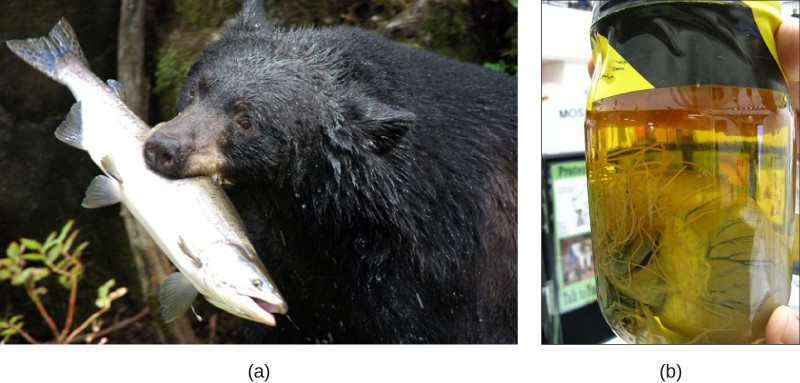
Fifty-fifty though members of the animal kingdom are incredibly various, animals share common features that distinguish them from organisms in other kingdoms. All animals are eukaryotic, multicellular organisms, and virtually all animals have specialized tissues. Well-nigh animals are motile, at least during sure life stages. Animals crave a source of nutrient to abound and develop. All animals are heterotrophic, ingesting living or dead organic matter. This form of obtaining energy distinguishes them from autotrophic organisms, such as most plants, which brand their ain nutrients through photosynthesis and from fungi that assimilate their food externally. Animals may exist carnivores, herbivores, omnivores, or parasites (Figure 1). Most animals reproduce sexually: The offspring pass through a series of developmental stages that plant a determined torso plan, different plants, for example, in which the exact shape of the body is indeterminate. The torso programme refers to the shape of an brute.
Complex Tissue Structure
A authentication trait of animals is specialized structures that are differentiated to perform unique functions. As multicellular organisms, most animals develop specialized cells that group together into tissues with specialized functions. A tissue is a collection of like cells that had a common embryonic origin. There are 4 main types of brute tissues: nervous, muscle, connective, and epithelial. Nervous tissue contains neurons, or nerve cells, which transmit nervus impulses. Musculus tissue contracts to crusade all types of body motion from locomotion of the organism to movements inside the body itself. Animals also have specialized connective tissues that provide many functions, including transport and structural back up. Examples of connective tissues include blood and bone. Connective tissue is comprised of cells separated past extracellular cloth fabricated of organic and inorganic materials, such as the protein and mineral deposits of bone. Epithelial tissue covers the internal and external surfaces of organs inside the brute body and the external surface of the body of the organism.
Brute Reproduction and Development
Most animals take diploid trunk (somatic) cells and a small number of haploid reproductive (gamete) cells produced through meiosis. Some exceptions exist: For example, in bees, wasps, and ants, the male is haploid considering information technology develops from an unfertilized egg. Near animals undergo sexual reproduction, while many also take mechanisms of asexual reproduction.
Sexual Reproduction and Embryonic Development
Almost all animal species are capable of reproducing sexually; for many, this is the simply mode of reproduction possible. This distinguishes animals from fungi, protists, and bacteria, where asexual reproduction is common or sectional. During sexual reproduction, the male person and female gametes of a species combine in a process called fertilization. Typically, the small, motile male person sperm travels to the much larger, sessile female egg. Sperm class is diverse and includes cells with flagella or amoeboid cells to facilitate motion. Fertilization and fusion of the gamete nuclei produce a zygote. Fertilization may exist internal, especially in state animals, or external, as is common in many aquatic species.
Afterward fertilization, a developmental sequence ensues as cells divide and differentiate. Many of the events in development are shared in groups of related animal species, and these events are ane of the principal ways scientists classify high-level groups of animals. During development, fauna cells specialize and form tissues, determining their future morphology and physiology. In many animals, such every bit mammals, the young resemble the adult. Other animals, such as some insects and amphibians, undergo complete metamorphosis in which individuals enter one or more larval stages. For these animals, the immature and the adult take dissimilar diets and sometimes habitats. In other species, a process of incomplete metamorphosis occurs in which the young somewhat resemble the adults and go through a series of stages separated by molts (shedding of the skin) until they reach the concluding developed form.
Asexual Reproduction
Asexual reproduction, unlike sexual reproduction, produces offspring genetically identical to each other and to the parent. A number of creature species—especially those without backbones, but even some fish, amphibians, and reptiles—are capable of asexual reproduction. Asexual reproduction, except for occasional identical twinning, is absent in birds and mammals. The most common forms of asexual reproduction for stationary aquatic animals include budding and fragmentation, in which part of a parent individual can separate and grow into a new private. In contrast, a form of asexual reproduction found in certain invertebrates and rare vertebrates is called parthenogenesis (or "virgin beginning"), in which unfertilized eggs develop into new offspring.
Nomenclature Features of Animals
Animals are classified according to morphological and developmental characteristics, such as a body plan. With the exception of sponges, the animal body plan is symmetrical. This ways that their distribution of torso parts is balanced forth an axis. Additional characteristics that contribute to animal classification include the number of tissue layers formed during development, the presence or absence of an internal body cavity, and other features of embryological development.
VISUAL Connection
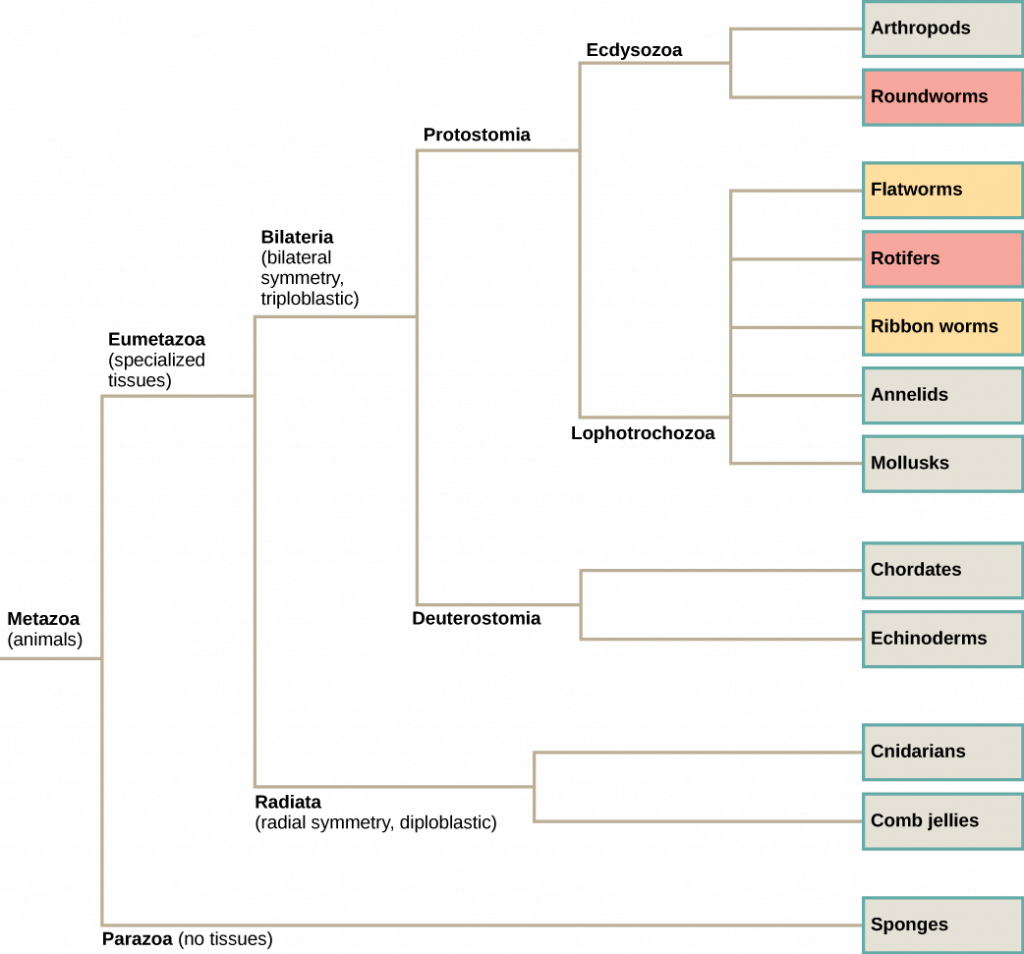
Which of the following statements is false?
- Eumetazoa take specialized tissues and Parazoa practice non.
- Both acoelomates and pseudocoelomates accept a trunk crenel.
- Chordates are more than closely related to echinoderms than to rotifers according to the figure.
- Some animals have radial symmetry, and some animals accept bilateral symmetry.
Reply:
Statement 2 is faux.
Torso Symmetry
Animals may be asymmetrical, radial, or bilateral in form (Figure 3). Asymmetrical animals are animals with no pattern or symmetry; an example of an asymmetrical creature is a sponge (Figure 3a). An organism with radial symmetry (Figure 3b) has a longitudinal (upwardly-and-down) orientation: Any plane cut along this upward–down axis produces roughly mirror-image halves. An instance of an organism with radial symmetry is a bounding main anemone.
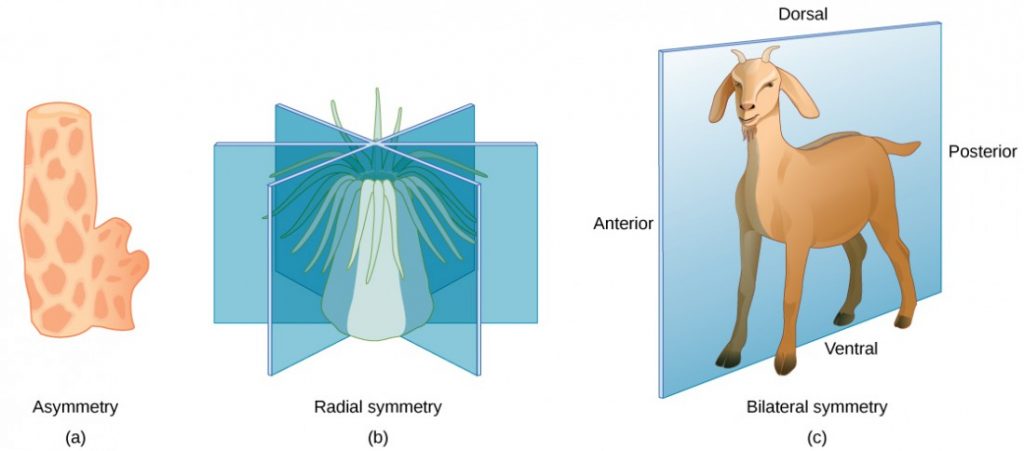
Bilateral symmetry is illustrated in Effigy 3c using a goat. The goat also has upper and lower sides to information technology, simply they are not symmetrical. A vertical plane cut from front to back separates the animate being into roughly mirror-image correct and left sides. Animals with bilateral symmetry also have a "head" and "tail" (anterior versus posterior) and a dorsum and underside (dorsal versus ventral).
CONCEPTS IN Activity
Lookout man this video to see a quick sketch of the different types of body symmetry.
Layers of Tissues
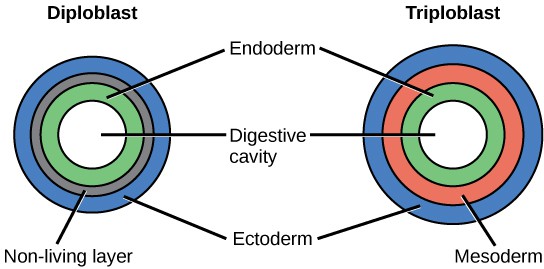
Most animal species undergo a layering of early on tissues during embryonic development. These layers are chosen germ layers. Each layer develops into a specific set of tissues and organs. Animals develop either ii or three embryonic germs layers (Figure 4). The animals that display radial symmetry develop 2 germ layers, an inner layer (endoderm) and an outer layer (ectoderm). These animals are called diploblasts. Animals with bilateral symmetry develop three germ layers: an inner layer (endoderm), an outer layer (ectoderm), and a center layer (mesoderm). Animals with three germ layers are called triploblasts.
Presence or Absence of a Coelom
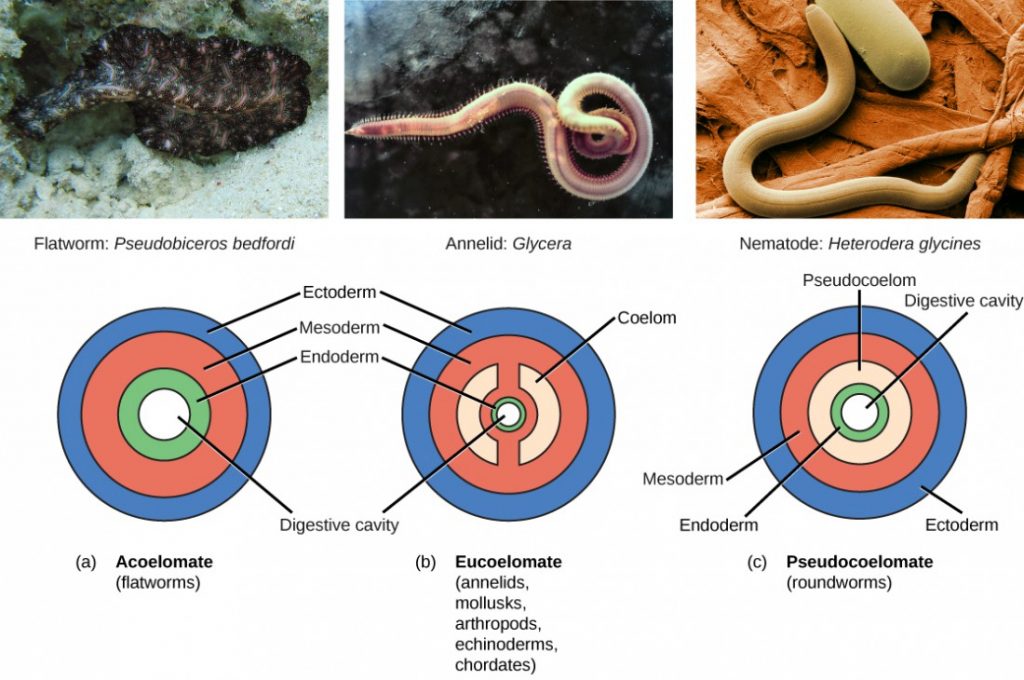
Triploblasts may develop an internal trunk crenel derived from mesoderm, called a coelom (pr. encounter-LŌM). This epithelial-lined cavity is a space, usually filled with fluid, which lies between the digestive system and the trunk wall. It houses organs such as the kidneys and spleen, and contains the circulatory system. Triploblasts that practice not develop a coelom are chosen acoelomates, and their mesoderm region is completely filled with tissue, although they take a gut crenel. Examples of acoelomates include the flatworms. Animals with a truthful coelom are called eucoelomates (or coelomates) (Figure 5). A true coelom arises entirely within the mesoderm germ layer. Animals such as earthworms, snails, insects, starfish, and vertebrates are all eucoelomates. A 3rd group of triploblasts has a trunk cavity that is derived partly from mesoderm and partly from endoderm tissue. These animals are called pseudocoelomates. Roundworms are examples of pseudocoelomates. New data on the relationships of pseudocoelomates suggest that these phyla are not closely related and so the development of the pseudocoelom must accept occurred more than once (Figure 2). True coelomates can be farther characterized based on features of their early embryological development.
Protostomes and Deuterostomes
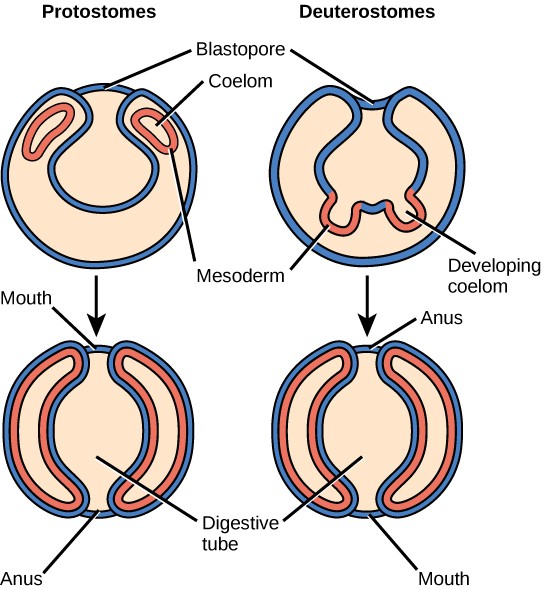
Bilaterally symmetrical, triploblastic eucoelomates can be divided into two groups based on differences in their early embryonic evolution. Protostomes include phyla such as arthropods, mollusks, and annelids. Deuterostomes include the chordates and echinoderms. These two groups are named from which opening of the digestive cavity develops starting time: mouth or anus. The word protostome comes from Greek words meaning "mouth first," and deuterostome originates from words meaning "oral cavity second" (in this instance, the anus develops beginning). This deviation reflects the fate of a structure chosen the blastopore (Effigy 6), which becomes the oral fissure in protostomes and the anus in deuterostomes. Other developmental characteristics differ between protostomes and deuterostomes, including the style of formation of the coelom and the early cell partitioning of the embryo.
- acoelomate
- without a body crenel
- asymmetrical
- having no plane of symmetry
- bilateral symmetry
- a type of symmetry in which there is only one plane of symmetry that creates two mirror-image sides
- body plan
- the shape and symmetry of an organism
- coelom
- a lined body cavity derived from mesodermal embryonic tissue
- deuterostome
- describing an brute in which the blastopore develops into the anus, with the second opening developing into the mouth
- diploblast
- an animal that develops from 2 embryonic germ layers
- eucoelomate
- describing animals with a trunk cavity completely lined with mesodermal tissue
- germ layer
- a collection of cells formed during embryogenesis that volition give rising to hereafter torso tissues
- protostome
- describing an animal in which the mouth develops first during embryogenesis and a second opening developing into the anus
- pseudocoelomate
- an animal with a coelom that is not completely lined with tissues derived from the mesoderm as in eucoelomate animals
- radial symmetry
- a type of symmetry with multiple planes of symmetry all cantankerous at an axis through the heart of the organism
- triploblast
- an animate being that develops from three germ layers
Admission for free at https://openstax.org/books/concepts-biological science/pages/1-introduction
Source: https://pressbooks.umn.edu/introbio/chapter/animalsfeatures/
Posted by: ramirezdadogiag.blogspot.com
0 Response to "What Is An Omnivore Bilateral Symmetry Animals"
Post a Comment